

Why Dog–Human Conflict Is Rising in Kerala ?
Kerala’s rising dog–human conflict is driven by rapid waste management reforms without parallel animal welfare systems, leading to food scarcity, stress, and increased street-level tensions.
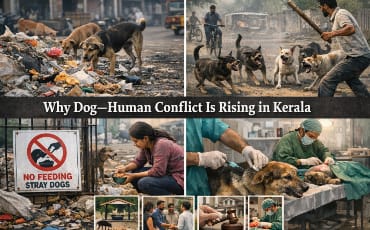
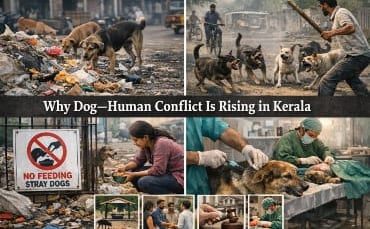
For decades, Kerala lived with a quiet, informal understanding between humans and stray dogs. It was never written into policy or law, yet it shaped everyday life across towns and cities. Stray dogs survived largely on open garbage, market waste, leftovers from households, and food discarded near shops and public spaces. This created an unplanned but stable food ecosystem. It was unhealthy, inefficient, and far from ideal, but it was predictable. Dogs knew where food would appear, and humans grew accustomed to dogs occupying certain spaces without constant confrontation.
That balance has now been disrupted, and the consequences are becoming increasingly visible on Kerala’s streets.
In recent years, the state has taken firm and necessary steps toward better waste management. Open dumping has been discouraged, decentralised waste processing has expanded, and cleanliness has become a public priority. From the perspective of public health, environmental protection, and urban dignity, these reforms were overdue and essential. Cleaner streets reduce disease, improve living conditions, and align Kerala with modern urban standards.
However, while waste management systems evolved rapidly, animal welfare systems did not expand at the same pace. The transition happened faster than the supporting structures needed to manage the stray animal population. For dogs that had depended on human waste for survival, the change was sudden and absolute.
For a stray dog, food scarcity is not a minor inconvenience. It is a biological emergency. Animal behaviour research consistently shows that abrupt loss of food sources leads to heightened stress, anxiety, and altered behavioural patterns. Hunger lowers fear thresholds and increases reactivity. When individual survival becomes uncertain, dogs naturally form groups, as pack behaviour improves their chances of finding food and defending territory. While this is a natural survival strategy, it also increases the likelihood of conflict, both among dogs and between dogs and humans.
Many people interpret these changes as dogs becoming aggressive or violent. In reality, what we are witnessing is a predictable response to environmental pressure. The dogs have not fundamentally changed; their surroundings have. Their behaviour reflects stress, insecurity, and competition over shrinking resources rather than an inherent tendency toward violence.
At the same time, citizens are increasingly discouraged or penalised for feeding stray dogs in public spaces. Housing associations pass bans, local bodies remove feeding bowls, and individuals who try to help animals often face social hostility or legal uncertainty. While some people adopt stray dogs or commit to feeding them regularly, this is not something most citizens can do consistently. Feeding becomes sporadic, unregulated, and unpredictable.
An unpredictable food supply often creates more behavioural instability than a consistently poor one. When dogs do not know when or where they will eat next, anxiety increases. In densely populated urban environments, where humans, vehicles, and animals constantly interact, stressed dogs are more likely to display defensive or pre-emptive behaviour. Barking, chasing, or biting incidents often stem from fear or perceived threat rather than deliberate aggression.
Kerala’s rising dog–human conflict, therefore, cannot be reduced to a simple narrative of dangerous animals or irresponsible citizens. It is better understood as a policy transition problem. The state moved decisively toward cleanliness and environmental reform but failed to simultaneously develop systems to manage the animal population that had depended on the previous waste structure.
Waste management policies were designed almost entirely around human hygiene and urban aesthetics. Animal welfare infrastructure, including regulated feeding systems, mass vaccination, sterilisation programs, and community engagement, lagged behind. This created a gap that has now produced unintended and harmful consequences for both people and animals.
Sterilisation and vaccination are often presented as standalone solutions, but they cannot succeed in isolation. A hungry and stressed dog is difficult to catch, vaccinate, or sterilise. Without stable feeding arrangements and community cooperation, these programs remain inconsistent and incomplete. Partial sterilisation allows population growth to continue, which increases competition for food and territory. This, in turn, escalates stress and conflict, creating a self-reinforcing cycle.
Public communication during this transition has also been inadequate. Citizens are told not to feed dogs but are rarely offered practical alternatives. Fear-driven narratives dominate media coverage and social discussions, portraying stray dogs as threats rather than sentient beings responding to sudden environmental change. This polarises society, pitting animal welfare advocates against residents demanding strict control or removal of dogs.
Kerala’s social and urban structure intensifies these tensions. High population density means streets are shared, intimate spaces rather than anonymous transit corridors. Conflicts are felt personally. Parents worry about children walking to school. Elderly residents fear using public roads. Feeders feel criminalised for acts of compassion. Municipal authorities are caught between public pressure and limited resources.
The solution does not lie in choosing between clean streets and animal welfare. These goals are not mutually exclusive. In fact, they depend on each other. Cleanliness without animal management creates instability. Animal welfare without urban planning creates friction. Both must move together.
Safer streets require regulated feeding zones that provide predictable food sources away from high-traffic areas. They require legal recognition and protection for registered community feeders who work in coordination with local authorities. They require feeding, vaccination, and sterilisation to function as an integrated system rather than fragmented efforts. Just as importantly, they require transparent public communication that explains why these measures matter and how they reduce long-term risk.
When dogs have predictable access to food, their stress levels decrease. When vaccination coverage improves, disease risks decline. When sterilisation is consistently implemented, population growth stabilises over time. Together, these measures reduce conflict and restore a sense of balance in shared spaces.
Kerala has already demonstrated leadership in waste management reform. The next step is to acknowledge that animals were an invisible stakeholder in the old system and must be consciously included in the new one. Ignoring this reality does not eliminate the problem; it merely pushes it into the streets, into daily fear, and into public outrage.
This is not a debate about whether dogs deserve compassion or whether humans deserve safety. Both are essential and non-negotiable. The real challenge lies in whether policy can recognise ecological interdependence instead of addressing issues in isolation.
Clean streets and public safety are achievable when environmental reforms and animal welfare progress together. Until that integration happens, Kerala is likely to continue experiencing the consequences of a transition that addressed cleanliness but overlooked coexistence.