

Safety vs 12 Million Jobs, The Truth About Quick Commerce
Quick commerce safety concerns are real, but so are 12 million livelihoods in India. This blog explores why safety and employment must be balanced, not opposed.
ECONOMY
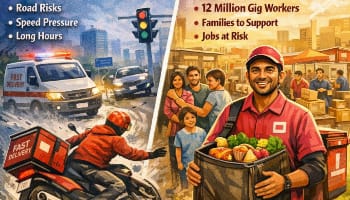
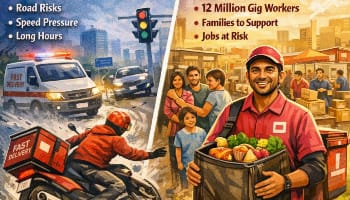
India’s gig economy has quietly become one of the largest employment engines in the country. Today, nearly 12 million people earn their living as gig workers, and a significant portion of them depend on quick-commerce platforms for their daily income. These platforms have not only transformed how consumers access essentials but have also created work opportunities for millions of young people who might otherwise struggle to find employment.
In recent times, however, there has been intense discussion around restricting or even shutting down quick-commerce services due to safety concerns. The concerns are real and valid. Delivery partners often face road risks, time pressure, long working hours, and unsafe traffic conditions. These issues cannot be ignored, and any responsible society must place human safety above convenience.
At the same time, it is important to look at the full picture before taking drastic steps. For many gig workers, quick-commerce is not a side hustle but their primary or only source of income. Their daily earnings support families, pay rent, cover education costs, and handle medical needs. A sudden shutdown or heavy restriction of these services would immediately cut off income for millions, pushing families into financial distress overnight.
The impact would not stop with delivery partners alone. Thousands of on-roll employees working in operations, warehouses, technology, customer support, and management would also be affected. Beyond that, the ripple effect would spread across the logistics, retail, and local supplier ecosystem. Small vendors, dark stores, transport services, and ancillary businesses that rely on quick-commerce demand would all feel the shock. In a country already dealing with employment challenges, especially among youth, such a move could sharply increase unemployment and economic uncertainty.
This is why the debate should not be framed as safety versus business, or safety versus livelihoods. The real challenge is how to ensure safety without destroying an entire source of employment. Shutting down an industry without creating alternatives risks creating problems far bigger than the ones we are trying to solve.
A more balanced and responsible approach is both possible and necessary. Safety standards can be made stricter without stopping services altogether. Unrealistic delivery speed expectations can be limited so that riders are not forced to take risks on the road. Companies can be mandated to provide proper insurance coverage, fair pay structures, and regular safety training. Stronger traffic rule enforcement can protect not just delivery workers but all road users. Technology can also play a powerful role by optimizing routes, reducing time pressure, and monitoring unsafe practices in real time.
The goal should be reform, not removal. Regulation should focus on correcting what is broken rather than dismantling what provides livelihoods to millions. Safety improvements take time, planning, and cooperation between companies, policymakers, and workers, but they are achievable.
My view is simple. We must stand firmly for safety without compromise. But we must also stand for livelihoods. Before any service is restricted or stopped, there should be a clear, realistic employment and transition plan for every worker who will be affected. In a country like India, safety and employment cannot be treated as opposing forces. They must move forward together, hand in hand.