

Reviving the Natural Tradition of Feeding Birds
Revive the natural tradition of feeding birds using hanging grain feeders made from paddy and natural grains, an eco friendly and compassionate way to support bird life.
ENVIRONMENT
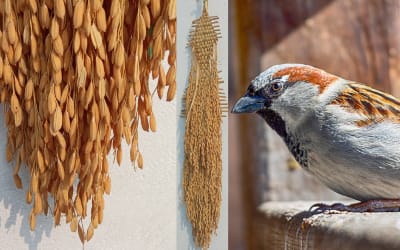
In a time when human life is becoming faster, louder, and increasingly detached from nature, small forgotten traditions carry immense power to heal the invisible wounds we have caused to the natural world, and one such tradition is the simple act of hanging natural grain bundles for birds, especially those made from paddy or unhusked rice spikes.
These hanging grain feeders are not decorative objects, tools, or household items; they are pure food sources created in the most natural form possible, designed to serve birds in a way that respects their instincts, biology, and freedom. For centuries, rural communities across Asia instinctively practiced this method without naming it or commercializing it after harvesting rice fields, farmers would save a portion of dried paddy ears, tie them with jute fiber or plant twine, and hang them near homes, trees, or barns so birds could feed during lean seasons.
This act was never considered charity but coexistence, a silent understanding that humans and birds share the same land and must care for each other to survive. Paddy grain hangers are uniquely suited for birds because they provide food in its most original form, still protected by husk, free from processing, chemicals, and artificial handling. Birds naturally recognize paddy as food, perch comfortably on the hanging bundle, and peck grains slowly, just as they would in open fields, which reduces stress, aggression, and dependency often seen with modern plastic feeders.
In today’s urban environments, birds face unprecedented challenges trees are cut down, wetlands are filled, insects disappear due to pesticides, and glass and concrete landscapes offer little food or shelter. Climate change further disrupts migration and breeding cycles, leaving many species hungry and vulnerable, while plastic pollution introduces deadly risks through ingestion and entanglement.
In this context, a natural hanging grain feeder becomes more than food; it becomes a lifeline. Unlike artificial feeders that require constant refilling, cleaning, and human control, grain hangers allow birds to feed independently, choose their timing, and consume food gradually over days, making the process sustainable and harmonious. Creating one requires no special skill or expense only dried paddy spikes, natural thread, and a few minutes of care yet its impact ripples outward, attracting sparrows, finches, munias, doves, and other small birds that once lived abundantly alongside humans.
Hanging these feeders on balconies, trees, or windows reconnects people with the rhythms of nature, transforming silent concrete spaces into living environments filled with movement, sound, and life.
Children who grow up watching birds feed from these grain bundles learn empathy not from lectures but from observation; they understand kindness as action rather than words, and responsibility as daily care rather than abstract ideas. Emotionally and spiritually, feeding birds has long symbolized gratitude, humility, and compassion across cultures, reminding humans that prosperity carries the duty to share, especially with beings who cannot ask for help.
Environmentally, this practice is perfectly circular the materials are biodegradable, the grains are consumed completely, leftovers return to soil as compost, and nothing harms the ecosystem. In contrast to plastic feeders that crack, pollute, and eventually become waste, a paddy grain hanger leaves no trace except nourishment.
As birds return daily to feed, they also bring balance by controlling insects, spreading seeds, and restoring a sense of ecological harmony that modern life has disrupted. This single act quietly challenges the idea that progress must come at the cost of nature, proving instead that thoughtful simplicity can coexist with modern living.
Hanging grain feeders do not demand wealth, technology, or recognition; they demand awareness, patience, and care, qualities that define humanity at its best. In choosing to revive this tradition, people do not merely help birds survive they reclaim a lost relationship with the natural world, one where humans are not owners of the Earth but participants in its shared life.
When birds return to our homes, mornings regain their music, spaces feel alive rather than empty, children grow gentler, and nature begins its slow, silent healing. This is not nostalgia; it is necessity. In a world searching for solutions to environmental collapse, the answer sometimes hangs quietly outside our windows, swaying in the wind, made of grain, kindness, and memory.