
India’s Silent Silicon Revolution DHRUV64 and the Rise of Indigenous Computing
DHRUV64 marks India’s quiet leap toward Aatmanirbhar Bharat, a homegrown 64-bit processor driving secure, efficient, and scalable digital infrastructure.
TECHNOLOGY
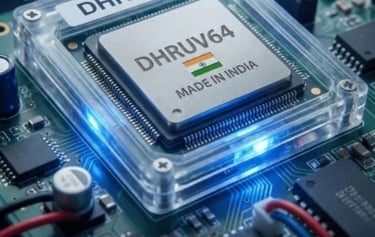
In a country where public attention is often consumed by Bollywood releases, cricket scores, and the noise of daily politics, some of the most transformative achievements happen quietly. One such milestone is the development of DHRUV64, a fully indigenous 64-bit microprocessor that marks a decisive step in India’s long journey toward technological self-reliance. Developed by the Centre for Development of Advanced Computing (C-DAC) under the Microprocessor Development Programme (MDP), DHRUV64 is not just another chip it is a statement of intent. It reflects India’s growing confidence in designing complex computing systems from the ground up, without dependence on foreign intellectual property or closed architectures.
DHRUV64 is engineered as a modern 1.8 GHz, 64-bit dual core processor, built on the open source RISC-V architecture, which allows India to innovate freely without licensing constraints. Its architecture is designed to deliver higher efficiency, better multitasking capabilities, and improved system reliability features that are essential for today’s compute intensive environments. Unlike legacy processors designed for narrow use cases, DHRUV64 is built with flexibility in mind, enabling seamless integration across a wide range of hardware platforms. This makes it well suited for critical domains such as 5G infrastructure, automotive electronics, industrial automation, consumer devices, and the rapidly expanding Internet of Things ecosystem. In a world increasingly defined by connected systems, such adaptability is not a luxury but a necessity.
What makes this achievement strategically important is not just performance, but sovereignty. India currently consumes a significant share of the world’s microprocessors, yet relies heavily on imports for core computing technologies. DHRUV64 helps address this imbalance by strengthening domestic capabilities in advanced chip design and validation. Its fabrication leverages industry grade semiconductor technologies used in high performance processors globally, positioning India as a serious participant in the semiconductor value chain rather than merely a consumer. More importantly, it creates a foundation for nurturing local talent, enabling engineers, researchers, and startups to innovate on a processor designed within the country, for the country and potentially for the world.
DHRUV64 is also part of a larger national vision under the Digital India RISC-V (DIR-V) Programme, which aims to establish India as a global hub for Electronics System Design and Manufacturing (ESDM). It stands on the shoulders of earlier indigenous processor initiatives that have steadily built India’s credibility in this space. From SHAKTI, developed by IIT Madras for strategic and defence applications, to AJIT from IIT Bombay for industrial and robotics use, and more recent processors like VIKRAM for space missions and THEJAS64 for industrial automation, each project has added a crucial layer of expertise. DHRUV64 represents the maturation of these efforts, where research, industry, and national strategy converge into a deployable, scalable product.
The broader significance of DHRUV64 extends beyond hardware. By embracing open-source architecture, the DIR-V initiative removes long term licensing costs, avoids vendor lock-in, and ensures sustained deployment across platforms for decades. This approach empowers Indian institutions, startups, and manufacturers to build customized systems without compromising security or autonomy. With future variants like DHANUSH64 and DHANUSH64+ SoC already under design, the roadmap signals continuity rather than a one off success. It shows that India is no longer experimenting at the margins of chip design but committing to a structured, long-term ecosystem.
Ultimately, DHRUV64 is more than a processor etched in silicon. It is a quiet but powerful reminder that nation building today happens as much in clean rooms and design labs as it does on playing fields or cinema screens. It reinforces the idea that Aatmanirbhar Bharat is not about isolation, but about strength having the capability to build secure, reliable digital infrastructure on our own terms. In an era where control over computing power increasingly defines economic and strategic influence, DHRUV64 stands as a symbol of India’s readiness to shape its own digital future.