

How We Are Slowly Killing Our Soil ?
Explore how harmful agricultural practices like stubble burning and overuse of chemicals are damaging soil health and what sustainable methods can save our land.
AGRICULTUREENVIRONMENT
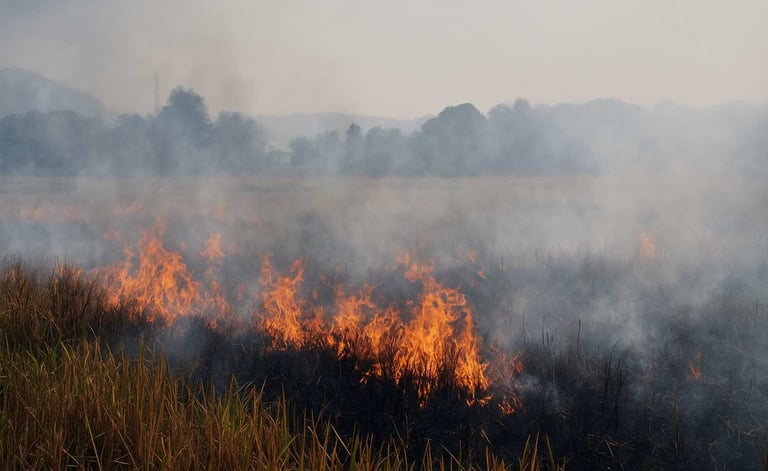
In a predominantly agricultural country like India, farming is not just an occupation it is a way of life for millions. Fields, crops, seasons, and soil define the daily rhythm of a farmer’s world. But as modern technology and chemical fertilizers entered agriculture on a large scale, the quantity of post-harvest crop residue also increased rapidly. After harvesting crops like rice, wheat, sugarcane, cotton, and maize, large amounts of dry stalks, husk, leaves, and stubble remain in the fields. In earlier times, much of this residue was used as fodder for cattle or left in the soil to decompose naturally. However, with the arrival of machines like combine harvesters, crop cutting became faster, but huge piles of stubble were left behind hard and fibrous enough to make manual removal difficult. This is why many farmers began choosing the quickest method burning the residue.
Burning crop residue appears to be a simple solution on the surface. The field becomes clean within hours, sowing for the next crop becomes easier, additional labor cost is saved, and the work finishes faster. But behind this seemingly easy method hides a harsh reality that often gets ignored. Burning stubble severely harms the soil, the air, human health, animal health, water quality, and the overall environment. The smoke that rises from burning fields spreads across the sky and creates smog, which pollutes villages and big cities alike. This smoke contains toxic gases such as carbon monoxide, sulfur dioxide, nitrogen oxides, and fine particulate matter dangerous pollutants that travel long distances and cause respiratory diseases.
Every year, during October and November, northern India’s atmosphere becomes heavily polluted. Cities like Delhi, along with many regions of Punjab and Haryana, get covered in thick layers of smog. Schools shut down, hospitals overflow with patients, and the air quality reaches hazardous levels. Although the fire starts in the fields, its impact spreads across the nation.
When a farmer sets fire to crop residue, the temperature of the soil surface quickly rises to 400–500°C. At such extreme heat, millions of beneficial microorganisms that live in the soil die instantly. These organisms help the soil breathe, maintain its softness, create nutrient cycles, and strengthen plant roots. Without them, the soil becomes harder, loses water-holding capacity, and its natural fertility gets damaged. To compensate, farmers are forced to use more chemical fertilizers in the next crop, increasing production costs and slowly turning fertile land barren.
During burning, the carbon present in the residue escapes into the atmosphere as smoke. While carbon is essential for soil fertility, in the air it acts as a pollutant and contributes to global warming. The residue also contains nitrogen, phosphorus, and potassium major nutrients required for crop growth but burning destroys all of them. Fields where stubble is regularly burned show reduced crop yields over time, although the damage isn’t visible immediately. It takes several years for the soil’s fertility to noticeably decline.
Crop residue burning affects not only the soil and air but also human and animal health. The smoke causes eye irritation, headaches, coughing, breathlessness, asthma, and bronchitis. Children, the elderly, and pregnant women are particularly vulnerable. Livestock also suffer from respiratory problems, and pregnant cattle may face complications. Milk-producing animals become stressed, reducing productivity.
Climate change is another major concern. Burning millions of tons of residue releases greenhouse gases like carbon dioxide and methane into the atmosphere, accelerating global warming. Rising temperatures, unpredictable rainfall patterns, droughts, floods, and sudden weather changes are all long-term consequences.
But the important question is can this problem be solved? Can stubble burning be stopped, and can farmers be offered practical solutions? The answer is yes. With the right tools, awareness, support, and alternatives, crop residue can become a valuable resource rather than a burden.
Today, various machines are available in India that help manage crop residue without burning it. Tools like the Happy Seeder, mulcher, rotavator, and reversible plough cut and mix the residue back into the soil, improving its organic content. This method also increases soil moisture, reduces weed growth, and helps retain nutrients. Baler machines collect the residue and convert it into compact bales that can be transported to industries. These industries use the material to produce biofuel, cardboard, paper, and energy. This turns waste into a source of income for farmers.
With proper scientific treatment, rice straw can also be turned into nutritious cattle feed. In many places, farmers mix cow dung, soil, and crop residue to produce organic compost, which enriches soil fertility and reduces dependence on chemical fertilizers. Vermicompost, biofertilizer, and natural manure are sustainable alternatives that support soil health.
Residue is also used for mulching, a technique where dry plant matter is spread around the roots of crops. Mulching helps maintain soil moisture, control temperature, and suppress weed growth. It reduces irrigation costs and promotes healthier plant growth.
Crop residue can even be used in biogas plants. Many rural communities are adopting village-level biogas systems where residue, cow dung, and organic waste are converted into fuel and organic fertilizer. This provides clean energy to the community while reducing pollution.
The truth is that stubble burning is not just a habit it has become a necessity for many farmers due to lack of time, resources, machinery, or affordable alternatives. Many farmers understand the harmful effects, but they do not have practical options. That is why it is the responsibility of the government, society, and institutions to provide machines, subsidies, awareness programs, and proper infrastructure. If villages have residue collection centers, rental machine banks, and industries that buy stubble at a fair price, the practice of burning can be eliminated.
If we want to protect the environment, preserve soil fertility, and give future generations clean air, then crop residue burning must stop. This is not only an agricultural issue it is an environmental and human issue. Protecting the Earth is our shared duty. The soil gives us life: food, water, air, and sustenance. Taking care of it should be our priority.
Sustainable farming is the future, and using nature’s resources wisely is the only way forward. Crop residue management is not just a technique it is a necessity for a healthier planet, healthier people, and a stronger farming system.