How Humanity Lost Its Natural Sense ?
humans have no humic sense” captures the greatest tragedy of modern civilization. We have become technologically advanced but spiritually hollow, globally connected but personally disconnected.
ENVIRONMENT
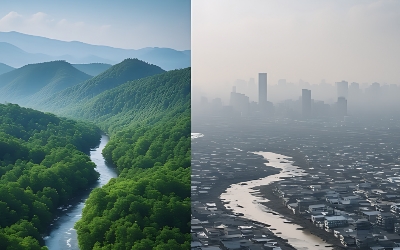
Modern humans like to believe that they stand at the peak of evolution, intelligence, innovation, and civilization. Yet beneath the comfort of technology and the illusion of mastery over nature lies a silent, invisible, and painful truth humans have lost their humic sense. This humic sense is not merely a biological instinct or ancient survival mechanism, but a profound connection to soil, nature, intuition, rhythm, harmony, and the organic wisdom that once guided human life. The word humic comes from humus, meaning the dark, fertile, life-giving soil from which all organisms rise and to which all things eventually return. In earlier eras, humans lived not only on the earth but with the earth. They understood the language of seasons, the moods of forests, the warnings of winds, and the subtle signals of animals. Their wisdom was not confined to intellectual theories or technological data it was embedded in their instincts, in their senses, in their cultural rhythms, and in their ways of living. They belonged to nature, and nature belonged to them. Today’s humans, however, exist separated from this foundation, disconnected from the soil that created them.
Humanity didn’t lose the humic sense suddenly; it eroded over centuries. The earliest shift happened during the agricultural revolution, when humans stopped roaming forests and settled into permanent structures. Ownership of land replaced coexistence with nature. The earth became an asset rather than a mother. As civilizations grew, people began shaping land according to their needs rather than aligning themselves with natural cycles. This shift deepened during the industrial revolution, when machines replaced natural rhythms. People no longer woke with the sun or rested with dusk; instead, they obeyed clocks, alarms, and factory bells. Smoke, steel, and artificial lighting became the new environment. The natural world slowly disappeared from daily life. The digital revolution completed this separation. Humans today interact more with screens than soil, more with simulations than reality. They depend on artificial intelligence more than their own instincts. They feel anxious when WiFi disconnects but feel nothing when their connection with nature disappears.
This loss shows up in every layer of modern life. The human mind, once steady like a rooted tree, now behaves like a restless bird fluttering inside a cage. Anxiety, stress, emotional instability, and inner emptiness are signs that humans have lost the grounding that nature once provided effortlessly. The body too carries scars of this loss. Circadian rhythms, once synchronized with sunrise and sunset, are now distorted by artificial lights and screens. Children grow without touching soil, breathing fresh air, or climbing trees. Immunity weakens because the microbes of soil no longer enter the body. Instead of living under open skies, humans live inside cement boxes illuminated by artificial light. The instincts that once warned humans of danger or helped them sense natural changes have been replaced by apps, weather forecasts, and digital alerts. People no longer trust their bodies or intuition; they trust data.
Even emotions have transformed. Humans are more connected globally than ever before but feel more alone than any generation before them. The absence of humic sense has created a psychological vacuum where relationships feel shallow, conversations feel scripted, and people remain emotionally displaced even while living in crowded cities. Cultural traditions, which once derived their meaning from natural cycles, have become mechanical repetitions. Festivals based on harvest, seasons, or celestial events are now celebrated without understanding their origins. People light lamps, break coconuts, or decorate houses not because they understand natural symbolism, but because society expects them to. Thus culture becomes hollow when its roots in nature break.
The relationship between humans and nature has become transactional. Forests are valued for timber, rivers for water supply, animals for products, mountains for minerals, and land for real estate. The earth is treated not as a living entity, not as a stabilizing force, not as a cosmic heritage, but as a commodity. This mindset is the clearest proof that the humic sense has vanished from modern humanity. When humans destroy forests for profit, poison rivers with chemicals, burn mountains for minerals, or kill animals for luxury, they reveal their deep amnesia about their own origins. A species that forgets its roots eventually becomes rootless.
Technology, though a blessing in many ways, has accelerated this disconnection. Instead of observing the sky, people check weather apps. Instead of listening to their bodies, they follow diets recommended by influencers. Instead of forming genuine human bonds, they scroll through profiles and connect through screens. Technology replaces instinct, data replaces wisdom, and algorithms replace inner judgment. Humans now behave like extensions of their own devices, responding to vibrations, notifications, and digital cues rather than natural rhythms. This artificial intelligence-driven existence makes life efficient but empties it of depth.
The tragedy deepens when we consider the future. Can humans survive without the humic sense? Physically perhaps yes, because technology can replicate many aspects of natural living. But emotionally, spiritually, ecologically, and psychologically, the answer is no. Without grounding, humans become anxious. Without nature, they become restless. Without intuition, they become confused. Without natural cycles, they become chronically ill. Without a sense of belonging to earth, they become lonely. A species detached from the soil will eventually collapse from within, not because of lack of intelligence, but because of lack of meaning.
Yet hope remains. The humic sense is not completely extinct; it is dormant, buried under layers of modern living, waiting to awaken. Restoration requires conscious effort. Humans must step outside concrete walls and return to nature, even in small ways. Touching soil, growing plants, walking barefoot on grass, breathing under open skies, listening to natural sounds, spending time near water bodies these simple acts reconnect the mind with the earth. Reducing digital dependency, even for an hour a day, creates mental silence in which natural intuition can return. Reconnecting with traditional knowledge, natural foods, seasonal routines, and cultural practices reawakens the ancient rhythm that lies within the human body. The earth does not demand sacrifices it simply asks for presence.
Spiritual traditions across the world remind humanity of its origin: “From dust you came, and to dust you shall return.” The human body contains minerals from soil, salts from oceans, air from forests, and heat from the sun. The humic sense is not just a metaphor it is a biological truth, a spiritual link, an emotional grounding, and a psychological necessity. When humans forget the earth, they forget themselves. When they return to the earth, they rediscover their identity.
In conclusion, the statement “humans have no humic sense” captures the greatest tragedy of modern civilization. We have become technologically advanced but spiritually hollow, globally connected but personally disconnected, intellectually sharp but emotionally confused, materially wealthy but internally bankrupt. We have conquered mountains but lost the ability to sit peacefully on the ground. We have explored planets but forgotten the soil beneath our feet. We have built skyscrapers but lost the instinct that once guided our ancestors through forests and storms. The loss of humic sense is not simply the loss of a biological feature it is the loss of humanity’s foundation, the loss of clarity, the loss of inner balance, the loss of the very wisdom that once made humans truly human. The path forward is not to reject modernity but to balance it with groundedness. Humanity must learn to live with technology without abandoning nature. Only then can the humic sense return, and with it, the stability, peace, and wisdom that modern humans unknowingly crave.