

Greek Warriors of Himera The Battle That Shaped 480 BC
Explore the Battle of Himera (480 BC), where Greek warriors faced Carthage as Salamis raged afar. Archaeology reveals sacrifice, synchronicity, and a turning point in Greek history.
ANCIENT HISTORY
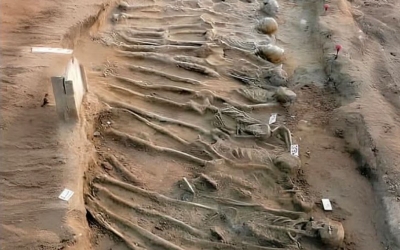
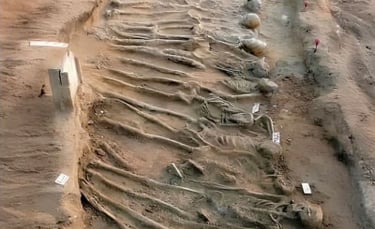
History often remembers its turning points through famous names Salamis, Marathon, Thermopylae. Yet some moments, equally decisive, remain quieter, half-buried in soil and memory. The skeletal remains unearthed near modern day Palermo, Sicily, belong to one such moment: the Battle of Himera in 480 BC. These bones, laid out in disciplined rows beneath the earth, tell a story of sacrifice, strategy, and a civilization fighting for its survival.
The archaeological site at Himera is striking in its silence. Rows of skeletons lie where they fell, aligned with a precision that suggests an organized burial carried out amid urgency and grief. These were not anonymous victims of a natural catastrophe; they were Greek warriors who stood in defense of their city and their way of life against a powerful enemy, the Carthaginians. Though weapons are absent, claimed by time or victors, the positioning of the bodies speaks clearly. Many skeletons show signs of violent death, with fractures and trauma consistent with close combat. Together they form a frozen echo of hoplite ranks that once clashed in dust and blood.
In 480 BC, Himera, a Greek city on the northern coast of Sicily, became the focal point of a massive Carthaginian invasion. Carthage was one of the most powerful states in the western Mediterranean and sought to eliminate Greek influence from the island. The Carthaginian army, led by Hamilcar, landed with overwhelming force and confidence. Facing them were the defenders of Himera, supported by reinforcements from Syracuse and Akragas under leaders such as Gelon and Theron. Against expectations, the Greeks achieved a decisive victory. Ancient accounts describe the Carthaginian camp being overrun and Hamilcar himself dying during the conflict. Himera was saved, but the cost of that victory is written into the soil through the graves left behind.
What makes the Battle of Himera truly remarkable is not only the outcome, but its timing. On the very same day, far to the east, another existential struggle was unfolding. While Greek soldiers fought Carthaginians on the plains of Sicily, Greek sailors and warriors confronted the Persian Empire at Salamis in the Aegean Sea. These two battles, separated by roughly 1,344 kilometers, occurred simultaneously at opposite ends of the Greek world. In both cases, Greek forces faced empires that threatened their independence, culture, and political traditions. In both cases, the Greeks emerged victorious.
This coincidence was more than symbolic. Had the Greeks lost at Salamis, mainland Greece might have fallen under Persian domination. Had they lost at Himera, Carthage could have crushed Greek Sicily and reshaped the balance of power in the western Mediterranean. Victory on both fronts ensured the survival of Greek city states across a vast geographic span. It allowed Greek culture, language, and political ideas to continue developing, eventually influencing Roman civilization and, centuries later, the foundations of the modern world. Concepts such as democracy, philosophy, theater, and scientific inquiry owe their survival to moments like this, when ordinary soldiers held the line.
The remains at Himera remind us that history is not an abstract sequence of dates and names. It is physical and human. Each skeleton represents a person who left home to fight, a family that waited for a return that never came, and a moment when the future of a civilization hung in the balance. Unlike monuments or texts written by victors, these bones do not exaggerate or glorify. They simply endure, bearing witness to what was lost so that something greater could survive.
Today, as attention drifts toward louder and more immediate narratives, the warriors of Himera lie quietly beneath the earth. Yet their story remains deeply relevant. They stood on one front of a vast and uncoordinated Greek resistance, unaware that on the same day their compatriots were fighting another decisive battle against another empire far away. Together, across land and sea, they protected the autonomy of their world.
The skeletal remains discovered at Himera are more than archaeological artifacts. They are a testament to resolve, endurance, and sacrifice. They remind us that civilizations are often preserved not by a single famous victory, but by many struggles, many lives, and many forgotten battlefields. Sometimes, history speaks most powerfully not through books or monuments, but from the ground beneath our feet.